The Story of South African Cuisine


7
South African cuisine is one of the world’s most diverse culinary traditions, reflecting thousands of years of indigenous food culture blended with influences from Africa, Europe, Asia, and the Middle East. Every major historical migration has left its mark on the country’s food, creating a cuisine that is rich, multicultural, and deeply connected to its landscapes and communities.
The First South Africans: Indigenous Food Traditions
Long before European settlement, the San (Bushmen) and Khoikhoi peoples lived across southern Africa. Their diets depended on hunting, gathering, and seasonal migration.
The San hunted antelope, springbok, kudu, ostrich, and smaller animals. They gathered edible roots, berries, wild melons, nuts, seeds, honey, and insects. Ostrich eggs served as water containers, while wild herbs flavored their meals.
The Khoikhoi were among the first pastoralists of southern Africa. They introduced cattle, sheep, and goats, producing milk, sour milk, and meat. Their cooking relied on roasting meat over open fires, a practice that eventually evolved into South Africa’s famous braai culture.
These indigenous food traditions emphasized sustainability, using every part of an animal and harvesting plants according to the seasons.
African Farming Communities
Around 2,000 years ago, Bantu-speaking peoples migrated southward into present-day South Africa.
They introduced:
- Sorghum
- Millet
- Beans
- Cowpeas
- Pumpkin
- Leafy vegetables
They also kept cattle, goats, and chickens.
Thick porridges made from sorghum or millet became staple foods. These were eaten with vegetable relishes, sour milk, or meat stews. Fermented beverages made from sorghum remain important in many traditional ceremonies today.
Dutch Settlement and the Cape Colony (1652)
The biggest turning point in South African cuisine came in 1652, when the Dutch East India Company established a refreshment station at the Cape under Jan van Riebeeck.
The Dutch brought:
- Wheat
- Vineyards
- Fruit orchards
- Cabbage
- Carrots
- Potatoes
- Onions
- Dairy farming
- Baking traditions
They also introduced European livestock and cooking methods.
Dutch settlers learned local food practices while adapting European recipes to African ingredients. The result was an entirely new colonial cuisine.
The Birth of Cape Malay Cuisine


6
Between the 17th and 19th centuries, enslaved people arrived from Indonesia, Malaysia, India, Sri Lanka, Madagascar, and East Africa.
Their culinary traditions transformed Cape cooking.
They introduced:
- Cinnamon
- Cloves
- Cardamom
- Turmeric
- Coriander
- Chili
- Tamarind
- Ginger
The result became known as Cape Malay cuisine, famous for its fragrant, mildly spiced dishes.
Classic dishes include:
- Bobotie
- Bredie
- Sosaties
- Denningvleis
- Samoosas
- Koeksisters
Cape Malay food remains one of South Africa’s greatest culinary treasures.
French Huguenot Influence
French Protestant refugees arrived in the late 1600s.
They contributed:
- Winemaking
- Cheese making
- Bread baking
- Fruit cultivation
South Africa’s famous wine regions around Stellenbosch, Paarl, and Franschhoek owe much of their heritage to these settlers.
British Influence
British rule in the nineteenth century introduced:
- Tea culture
- Fish and chips
- Roast dinners
- Meat pies
- Custards
- Cakes
- Afternoon tea
Many British dishes gradually blended with local ingredients and became uniquely South African.
Indian Influence


7
From 1860 onward, thousands of Indian indentured laborers arrived in Natal (modern KwaZulu-Natal).
They introduced:
- Curry
- Lentils
- Rice
- Pickles
- Flatbreads
- Chutneys
Durban became famous for producing some of the hottest curries outside India.
The most iconic invention is:
Bunny Chow
A hollowed loaf of bread filled with curry.
Despite its unusual appearance, Bunny Chow has become one of South Africa’s national dishes.
Other favorites include:
- Mutton curry
- Bean curry
- Roti
- Breyani
- Chili bites
Afrikaner Farm Cuisine
Boer settlers developed practical cooking suited to frontier life.
Meals focused on:
- Beef
- Lamb
- Venison
- Potatoes
- Pumpkin
- Corn
Popular dishes include:
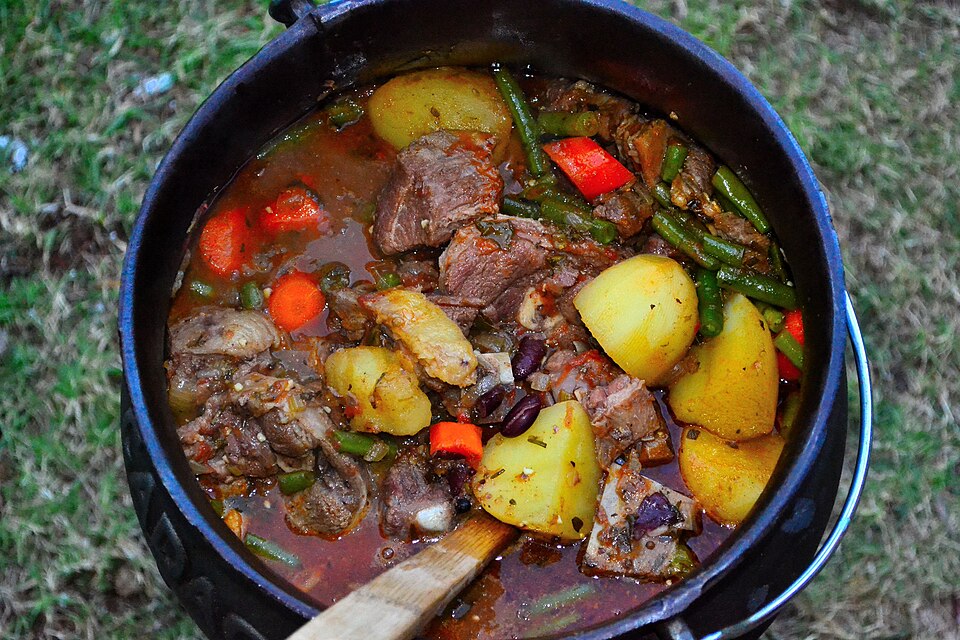
- Potjiekos
- Boerewors
- Biltong
- Rusks
- Melktert
These foods remain staples throughout South Africa today.
Braai: South Africa’s National Tradition
No food better represents South Africa than the braai.
A braai is far more than a barbecue.
Families and friends gather around wood fires to cook:
- Boerewors
- Lamb chops
- Steak
- Chicken
- Sosaties
- Pap
- Grilled vegetables
Every community has its own braai traditions, making it a symbol of national unity.
Staple Foods
Across South Africa, several staple foods appear in almost every household.
Pap
A thick maize porridge similar to ugali or sadza.
It is served with:
- Meat stew
- Tomato relish
- Spinach
- Gravy
Chakalaka
A spicy vegetable relish made from:
- Tomatoes
- Beans
- Carrots
- Onions
- Chili
It is commonly served alongside pap and grilled meats.
Morogo
Traditional leafy greens cooked with onions and tomatoes.
Samp and Beans
Crushed maize cooked slowly with beans.
Known by different names among different communities, it is an important comfort food.
Game Meat
South Africa is famous for its variety of game meats.
These include:
- Springbok
- Kudu
- Impala
- Ostrich
- Warthog
- Eland
Game is prepared as steaks, sausages, dried meat, or slow-cooked stews.
Coastal Cuisine
With coastlines on both the Atlantic and Indian Oceans, seafood plays a major role.
Popular seafood includes:
- Snoek
- Kingklip
- Yellowtail
- Hake
- Mussels
- Rock lobster
- Oysters
The West Coast is particularly known for seafood braais.
South African Desserts
Popular sweets include:
- Malva pudding
- Melktert (milk tart)
- Koeksisters
- Hertzoggies
- Peppermint Crisp tart
- Milk tart
- Fruit cakes
These desserts reflect Dutch, British, and Cape Malay influences.
South African Beverages
Traditional drinks include:
- Rooibos tea
- Honeybush tea
- Amarula cream liqueur
- Sorghum beer
- Ginger beer
- South African wines
- Craft beers
The Cape Winelands are internationally recognized for producing excellent Chenin Blanc, Pinotage, Shiraz, and Sauvignon Blanc wines.
A Cuisine of Unity
South African cuisine is often described as the “Rainbow Nation on a Plate.” It combines Indigenous African, Dutch, French, British, Cape Malay, Indian, Portuguese, and many other culinary traditions into a vibrant food culture. Whether it is a family braai, a fragrant Cape Malay bobotie, a spicy Durban bunny chow, or a simple bowl of pap with chakalaka, every dish tells a story of migration, adaptation, resilience, and cultural exchange.
Today, South African cuisine stands as one of the world’s most distinctive culinary traditions—celebrated for its diversity, bold flavors, and the way it brings people together around the table.

Recent Comments